
Choosing the right residential foundation for your New Orleans home isn’t just a construction decision; it’s one of the most important structural choices you’ll ever make.
The city’s famously challenging soil conditions, high water table, and below-sea-level terrain mean that what works in other parts of the country simply won’t cut it here.
Understanding the main types of foundations and how each holds up against New Orleans’ unique environment is the first step toward building or maintaining a home that lasts.
Why Foundation Choice Matters More in New Orleans Than Anywhere Else
New Orleans sits in one of the most geologically complex areas in the United States. Most of the city is actually below sea level, and the water table sits just one to two feet below the ground surface in many neighborhoods. That’s an extraordinary challenge for any foundation system.
The soil beneath the city is a mix of clay, silt, and peat, all of which are highly prone to shifting, compressing, and expanding depending on moisture levels.
Clay-heavy soils swell when wet and shrink when dry, creating constant movement beneath a structure. Saturated soil, meanwhile, loses its load-bearing capacity, which can lead to settling, cracking, and structural instability over time.
This is why choosing the right residential foundation in New Orleans isn’t something to leave to guesswork. It requires local expertise and a thorough understanding of site-specific soil conditions.
What New Orleans Homeowners Commonly Deal With
- Foundations settling or shifting due to expansive clay soils
- Water infiltration from a water table that sits just below the surface
- Cracking in slabs caused by soil movement after heavy rains
- Differential settling when one side of a home sinks faster than the other
- Old pier-and-beam homes showing signs of rot or deterioration in the crawl space
The 4 Main Types of Residential Foundations in New Orleans
Not every foundation type is suitable for every location. Here’s a breakdown of the most common options and how they perform in the New Orleans environment.
1. Slab-on-Grade Foundation
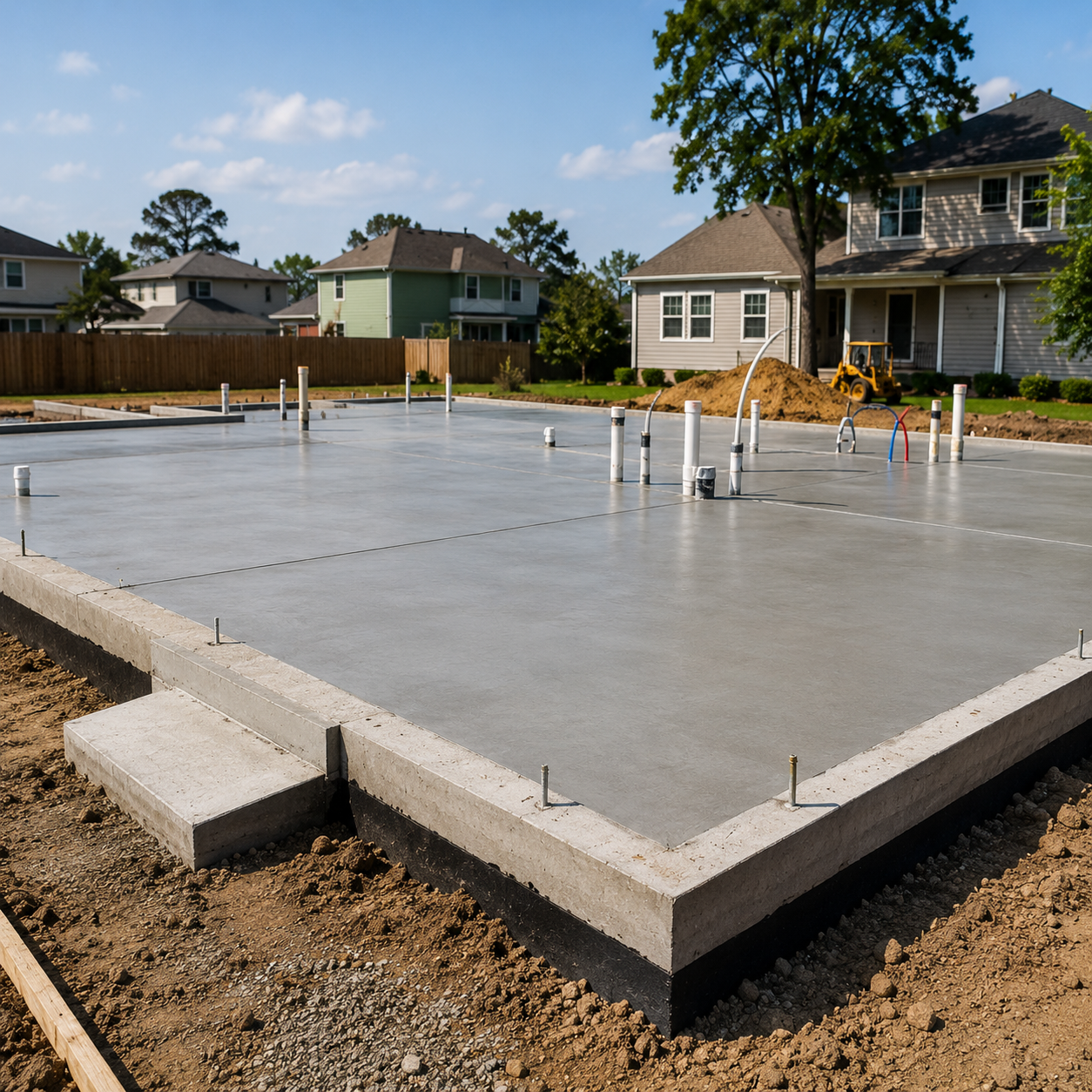 A slab-on-grade foundation involves pouring a flat concrete slab directly onto the prepared ground, which also serves as the floor of the home.
It’s a common choice in modern residential construction and works reasonably well in areas with relatively stable, well-compacted soil.
In New Orleans, slab foundations can be used, but they require careful site preparation to account for soil instability.
Without proper drainage management and soil compaction, slabs are vulnerable to cracking and uneven settling over time.
Pros of Slab Foundations in NOLA:
- Lower initial construction cost compared to pile systems
- No crawl space means fewer moisture-related issues underneath
- Faster to build and widely understood by local contractors
- Works well in areas with more stable, slightly elevated ground
Cons to Consider:
- More susceptible to cracking in areas with shifting clay soils
- Difficult and costly to repair plumbing or utilities embedded within the slab
- Requires excellent drainage and soil prep in flood-prone areas
Big Easy Concrete specializes in properly engineered slab foundations that account for local soil and drainage conditions.
2. Pier and Beam Foundation
Pier and beam is one of the most historically common foundation types in New Orleans, especially in older homes built before modern pile technology became widespread. This system uses vertical piers, typically concrete or wood, set into the ground at regular intervals, with beams spanning between them to support the floor structure above.
The space between the ground and the floor is known as the crawl space, which allows for easier access to plumbing and electrical systems and can provide some buffer against surface flooding.
Pros of Pier and Beam:
- A crawl space allows for easier repair and inspection of utilities
- Provides some elevation above ground level
- A solid choice for homes in areas with moderate soil movement
Cons to Consider:
- Wood components in the crawl space are vulnerable to moisture and rot in New Orleans’ humid climate
- Piers can sink or shift if not driven deep enough into stable soil
- Requires ongoing inspection and maintenance of the crawl space environment
3. Pile Foundation (Concrete or Steel Pilings)
For most of New Orleans, especially neighborhoods at or below sea level, pile foundations are the most reliable and widely recommended system. This involves driving concrete or steel pilings deep into the ground (sometimes 70 feet or more) until they reach a stable, load-bearing stratum of compressed clay far below the surface.
The home is then built atop a concrete grade beam or cap that ties the pilings together, distributing the structure’s weight onto solid ground deep below the problematic surface soils.
Pros of Pile Foundations:
- Bypasses the unstable surface soil entirely
- Highly resistant to settling and movement over time
- The standard system for new residential construction in NOLA
- Can accommodate the city’s extreme soil and water table conditions
Why It Works for New Orleans:
- Pilings are driven to depths where the soil is significantly more stable
- The system accounts for the proximity of the water table
- Used successfully across decades of residential and commercial construction in the region
Big Easy Concrete handles concrete pouring and foundation work with full awareness of what depth and system design is appropriate for each neighborhood.
4. Raised / Elevated Foundation
New Orleans has a long tradition of raised home structures elevated several feet above the ground on a combination of piers, pilings, or masonry walls. This approach was developed over centuries as a practical response to the city’s flood risk and high humidity.
A raised foundation offers meaningful protection against surface flooding and helps with air circulation under the home, which can reduce moisture buildup and the associated structural problems.
Pros of Raised Foundations:
- Excellent flood mitigation in low-lying neighborhoods
- Improved ventilation reduces humidity-related damage to floor joists and subfloors
- Historically proven in New Orleans’ climate
- Can be combined with pile systems for maximum stability
Considerations:
- Higher construction cost than a simple slab
- Requires proper enclosure and insulation of the elevated underside
- Stair access required, which may not suit all homeowners
So Which Foundation Is Best for Your New Orleans Home?
The honest answer: it depends on where in New Orleans you’re building, the existing soil conditions, and your home’s structural requirements. There’s no single “best” option that applies universally.
That said, here’s a general guide for New Orleans homeowners:
How to Choose Based on Your Situation
- New construction in low-lying or below-sea-level areas → Concrete pile foundation is almost always the right call
- Renovation or addition to an existing slab home → Evaluate current slab condition and drainage before proceeding
- Older pier-and-beam home showing settling signs → Inspection and potential underpinning with concrete pilings
- Elevated neighborhood or slightly higher ground → Slab or raised foundation may be viable with proper soil prep
- Flood-prone area near bayous or drainage canals → Raised or elevated pile system to maximize floor elevation
One factor that’s non-negotiable in any NOLA foundation project is drainage. Poor water management around a foundation accelerates every type of soil-related problem. Big Easy Concrete’s drainage and detention services are often part of a complete foundation solution.
Signs Your Current Foundation Needs Attention
- Cracks appearing in interior walls, particularly diagonal cracks near door and window frames
- Doors and windows that stick, won’t close, or have visibly shifted frames
- Uneven or sloping floors
- Gaps between the floor and baseboards
- Visible cracking on exterior concrete or masonry
If you’re seeing these signs, it’s worth consulting a professional sooner rather than later. Foundation issues don’t improve on their own.
Working With a Local Concrete Contractor Who Knows New Orleans
The biggest mistake homeowners make is hiring a contractor without local experience. Foundation systems designed for stable soil in other states are often completely inadequate for New Orleans.
You need a team that understands how the Mississippi River delta’s alluvial deposits behave, how deep pilings need to go in your specific neighborhood, and how to build a commercial foundation or residential system that holds up decade after decade.
Big Easy Concrete is native to Louisiana. We worked in the conditions you’re dealing with, not just read about them in a textbook. Whether you’re building new, repairing an existing foundation, or planning a significant renovation, the right foundation starts with the right conversation.
Big Easy Concrete serves homeowners across the Greater New Orleans area, including Metairie, Kenner, Gretna, Slidell, Covington, and more. Every project starts with a free estimate and an upfront price, no surprises.
If you’re planning a new build, dealing with an aging foundation, or simply want a professional opinion on what your home is sitting on, Big Easy Concrete offers free estimates across New Orleans and the surrounding areas. Reach out today and get the answers you need from a team that truly knows this city.
Frequently Asked Questions
Can you build a basement in New Orleans?
Basements are effectively impossible to build in most of New Orleans. The water table sits just one to two feet below the surface in many neighborhoods, and the city’s below-sea-level elevation means excavating any significant depth would immediately encounter groundwater. Traditional below-grade basements are not a viable option here.
How deep do foundation pilings need to go in New Orleans?
It varies by location and soil conditions, but in many areas of New Orleans, pilings are driven 40 to 70 feet deep or more to reach a stable load-bearing layer below the unstable surface soil. A geotechnical assessment helps determine the appropriate depth for any specific site.
What’s the most common foundation type in New Orleans homes?
Older homes in New Orleans commonly sit on pier-and-beam foundations, while newer residential construction more frequently uses deep concrete pilings with a grade beam. Slab-on-grade is also used in areas with more stable ground, though it requires careful engineering in this region.
How do I know if my foundation is failing?
Common warning signs include diagonal cracks near door or window corners, sticking doors and windows, uneven or spongy floors, visible gaps at the floor-wall junction, and cracks in exterior masonry or concrete. If you notice any of these, scheduling a professional inspection is the right next step.